Choose the place first
Look for a spot where you will enjoy seeing flowers during an ordinary day. A kitchen table, a low shelf or a desk corner offers different amounts of space. Notice how close people will sit and whether the arrangement will block a view, a cupboard or a light switch.
Consider the household before choosing varieties. Some flowers and plants are unsuitable around pets or children; check reliable guidance for the exact species if that is relevant to your home. Do not rely on a general description such as natural or seasonal as evidence of safety.
Take the vase into account
Measure or remember the vase opening and height. A wide mouth needs a different arrangement from a narrow bottle. Buying a small bunch for a very wide container may leave the stems falling outwards; a dense bunch can feel crowded in a narrow opening. You may already have a jug or vessel suitable for flowers, provided it is stable and can hold water safely.
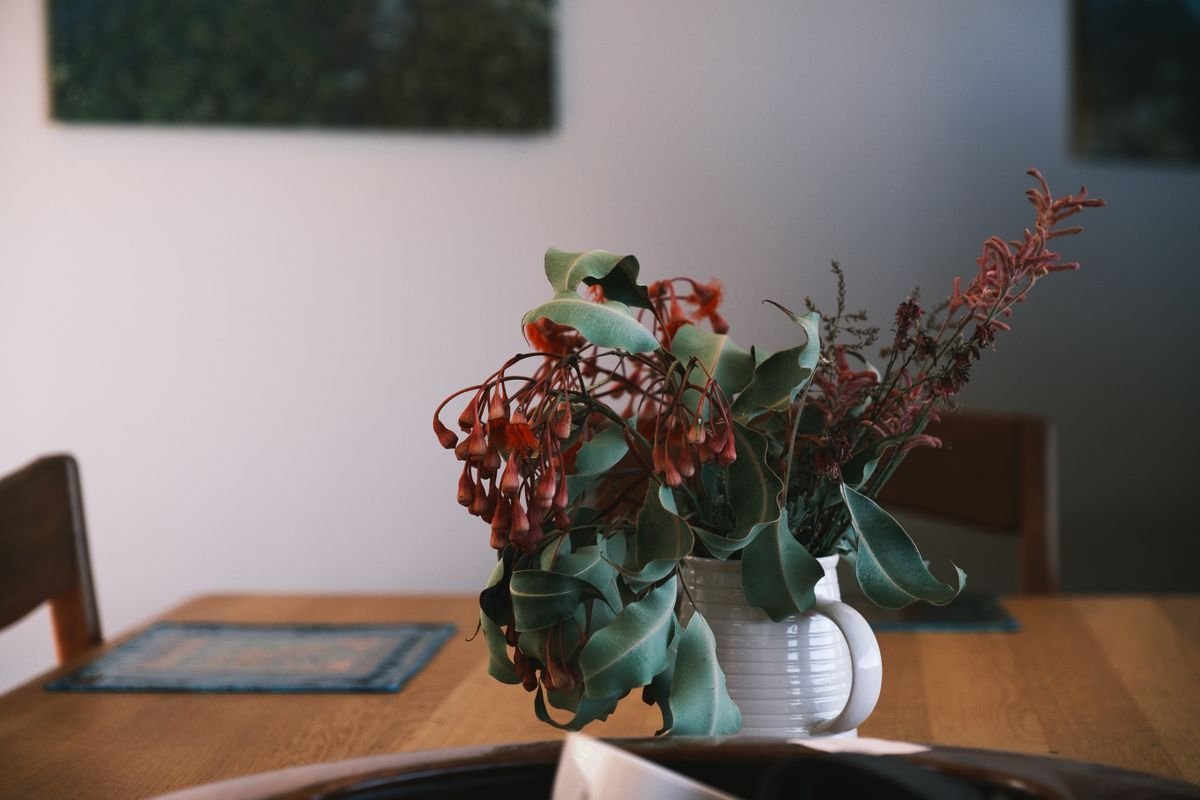
Think about the finished height. On a dining table, a low arrangement usually leaves a clearer view between people. On a side surface, taller stems may have room to spread. The flowers do not need to be the largest object in the room to be visible.
Select for shape as well as colour
Look at how the stems branch and how much space the heads occupy. A few open blooms can fill more room than a tight bunch of small ones. Choose colours in relation to what is already around the vase: a strong wall colour, a patterned curtain or a plain table.
You can make the arrangement quiet or contrasting. There is no need to match the room exactly. If you are unsure, a short palette can be easier to assess than a mixed bunch with several competing colours. Buy the amount your container and budget suit, not the amount needed for a display elsewhere.
Arrange where you can make a little mess
Prepare the flowers on a washable surface and follow the care advice for the varieties you bought. Use clean suitable tools carefully, and remove packaging before putting the bunch into its final position. Keep water away from surfaces or objects that could be damaged.
Turn the vase and look from the angle at which you will normally see it. An arrangement against a wall does not need to be identical on every side. Leave some natural space between stems if you like that effect rather than forcing every gap closed.
Let the arrangement become smaller
As individual stems fade, remove them according to their condition and care guidance. The remaining flowers may suit a smaller vessel. Moving them can extend your enjoyment of the arrangement without pretending it must remain exactly as bought.
When the flowers have gone, clean the vase and return the surface to use. The empty interval is useful too. It gives you a chance to decide whether that was the right spot before the next bunch comes home.