Keep one pattern familiar
Start with a printed garment you already wear comfortably. Then introduce a second pattern in a smaller area, such as a scarf, shirt collar or jacket. You can see how the relationship feels without committing every part of the outfit at once.
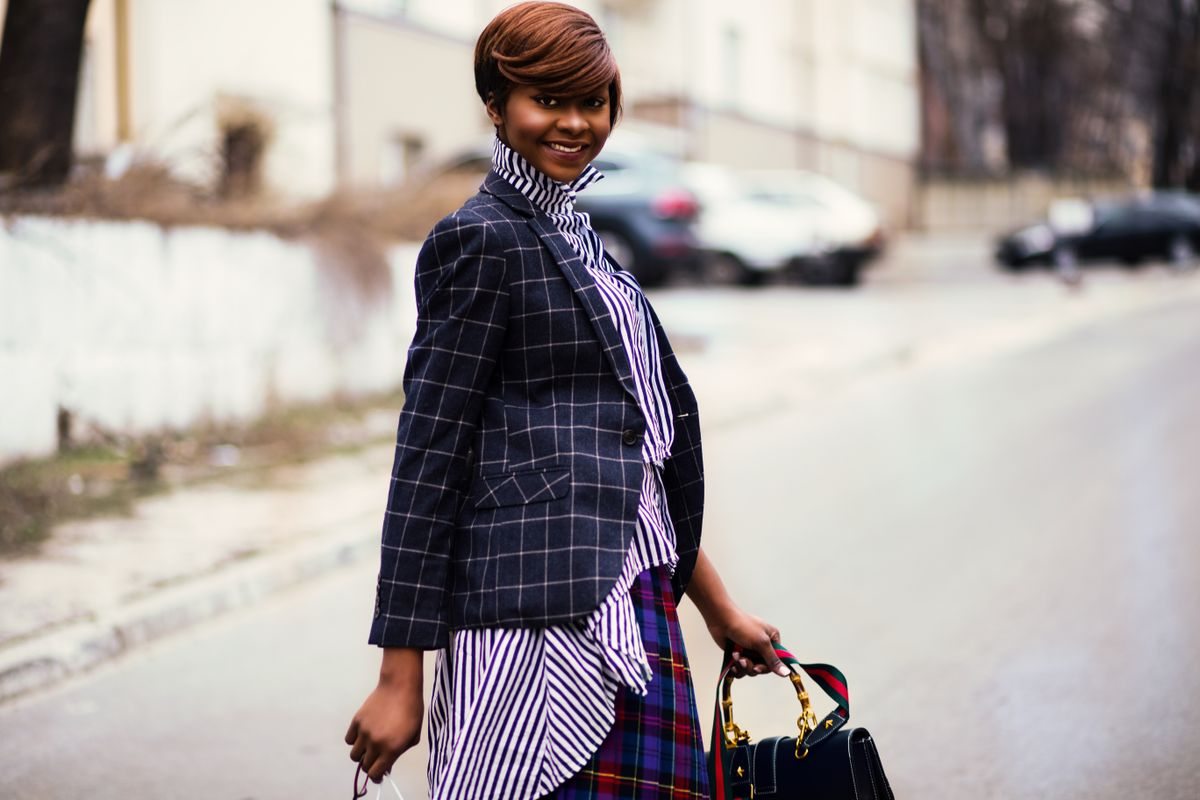
A striped top and checked jacket are one possibility. They work through different rhythms: one repeats in lines, the other in a grid. That difference can be more legible than two patterns of similar size competing for attention. It is an experiment, not a rule that stripes always belong with checks.
Compare scale
A fine pattern beside a larger one gives the eye different things to read. Two bold patterns may also work if you like the stronger effect, but they are harder to treat as a quiet combination. Stand back from the mirror to see whether one merges into a texture while the other remains distinct.
The size of the garment matters alongside the scale of the print. A large coat covered in a small check still occupies a substantial area. A tiny patterned bag may make very little difference. Judge the outfit as worn rather than counting the number of patterned objects.
Look for a connection
A shared colour can help the pieces sit together. Black lines in a striped shirt may relate to black in a checked jacket. The connection does not have to be exact or obvious; it can simply stop the two patterns from feeling unrelated to you.
If the colours are very different, try a plain garment between them. Dark trousers can give two patterned upper layers somewhere to settle. A solid coat can frame a printed dress and scarf. The plain space is useful when you want the combination to remain readable.
Remove competing details
When testing two patterns, keep jewellery and other accessories simple at first. That lets you see what the patterns themselves are doing. Once you like the result, you can add a detail if it contributes something you want.
A patterned piece with ruffles, contrast buttons and a large collar brings more than print into the outfit. Pairing it with another highly detailed garment may feel busy for reasons beyond the patterns. If the experiment does not work, change the shape or decoration before assuming the prints are incompatible.
Decide how much attention you want
Some days you may enjoy an outfit that is visually active; other days you may prefer one clear focal point. Both are reasonable. There is no achievement in wearing more patterns than feels comfortable, and no failure in returning to a plain partner.
Take a photograph from a normal viewing distance if the mirror becomes confusing. Look at the whole image, then remove one item and compare. The exercise should help you make a decision, not turn getting dressed into an endless search for approval from a styling formula.